
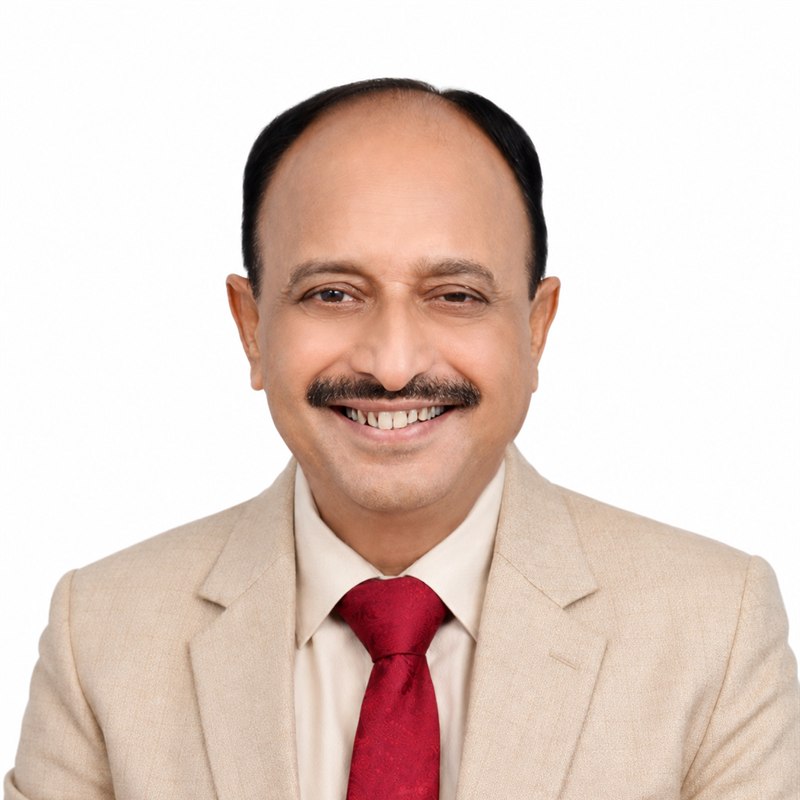
Agriculture changes the day the farmer is treated as an enterprise owner and the crop as a product with a buyer already waiting for it.
Pankaj Kumar Pathak is Chairman of GAMSME’s National Council on Agriculture and Allied Sectors and Chairman of Foodbuild Enterprises and Consulting LLP. An agricultural graduate of Marathwada Agricultural University at Parbhani, Maharashtra, now Vasantrao Naik Marathwada Krishi Vidyapeeth, he has spent his working life across two worlds that rarely meet in practice: the farm gate, where the crop is grown and sold at whatever price the day offers, and the national institutions where the rules on exports, research priorities, public services and worker welfare are actually written. He has served on the Authority of APEDA under the Ministry of Commerce and Industry, on the Institutional Management Committee of the ICAR National Research Centre on Pig, and on the Passenger Services Committee of the Railway Board, and is at present a Member of the Employees’ State Insurance Corporation under the Ministry of Labour and Employment.
From the farm gate to the food business
Shri Pathak’s training is in agriculture itself. A B.Sc. (Agri.) from the Parbhani university placed him in one of India’s more demanding farming regions, where dryland cropping, pulses and cotton leave very little margin for a farmer who has no route to a buyer. That grounding shows in the way he approaches the sector now. As Chairman of Foodbuild Enterprises and Consulting LLP, he works at the point where produce becomes product, where grading, processing, packaging, compliance and buyer relationships decide whether a farming household earns a commodity price or an enterprise margin.
That view sits squarely with GAMSME’s own position on the sector. Welfare should support, business should lead. Support schemes matter and should be used well, but sustained improvement in rural incomes comes from enterprises that sell, not from assistance that arrives and then stops.
Farmer representation in Assam
Shri Pathak served as State President of the Kisan Morcha, Bharatiya Janata Party, Assam Pradesh, the farmers’ wing of the party in the state. The role meant working directly with cultivators, farmer groups and district level organisation across Assam, hearing the same constraints repeated in different valleys, and carrying them upward to where policy is made. It gave him an organisational reach across the state and a first hand map of where the agricultural economy of the region breaks down, which is rarely at production and almost always at aggregation, processing and market access.
Service on national bodies
Four national appointments have given Shri Pathak an unusually wide view of the systems that surround Indian agriculture.
As an Authority Member of APEDA, the Agricultural and Processed Food Products Export Development Authority under the Ministry of Commerce and Industry, he sat on the body that shapes export promotion for scheduled agricultural and processed food products, covering standards, infrastructure support and market development. Exports are where Indian produce meets the sharpest quality and traceability requirements, and where the gap between what a small producer grows and what a foreign buyer will accept is most visible.
As a Member of the Institutional Management Committee of the National Research Centre on Pig, ICAR, under the Ministry of Agriculture and Farmers Welfare, he engaged with the national research institution for piggery, based at Rani near Guwahati. Pig rearing is among the most widely held livelihood assets in the Northeast, and the distance between research output and the smallholder rearing four or five animals is exactly the kind of gap GAMSME exists to close.
As a Member of the Passenger Services Committee of the Railway Board, Ministry of Railways, he worked on the passenger facing side of the largest logistics network in the country, an institution that also carries a substantial share of the agricultural produce moving between Indian states.
At present he serves as a Member of the Employees’ State Insurance Corporation under the Ministry of Labour and Employment, the tripartite corporation that administers social security for organised sector workers. The relevance to MSMEs is direct. As a small unit grows past the coverage threshold, ESIC becomes a live compliance obligation, and one of the first pieces of formal machinery a growing enterprise has to understand.
At GAMSME
As Chairman of the National Council on Agriculture and Allied Sectors, Shri Pathak leads GAMSME’s work across agriculture, horticulture, animal husbandry, agro-processing and the allied rural economy. The council’s scope runs from production and post-harvest handling through value addition, food safety and certification, to aggregation, buyer connect and export readiness, with farmer producer organisations, cooperatives and agri-MSMEs as its constituency. It anchors Krishi Udyam Setu, GAMSME’s demand led market access mission for the sector, and works alongside the councils on aquaculture, eco-tourism and tribal enterprise.
The council is also GAMSME’s institutional bridge into the agricultural establishment, with Central and State departments, ICAR institutions, NABARD, financial agencies and private sector buyers, and it is being built out with state coordinators and subject experts so that the work reaches districts rather than stopping at the national office. Shri Pathak describes the ambition as a Green Intelligence Revolution: the productivity gains of the last fifty years combined with the intelligence, systems and enterprise thinking the next fifty will need, in service of a Viksit Bharat by 2047.